What the research says
What forward head posture actually is
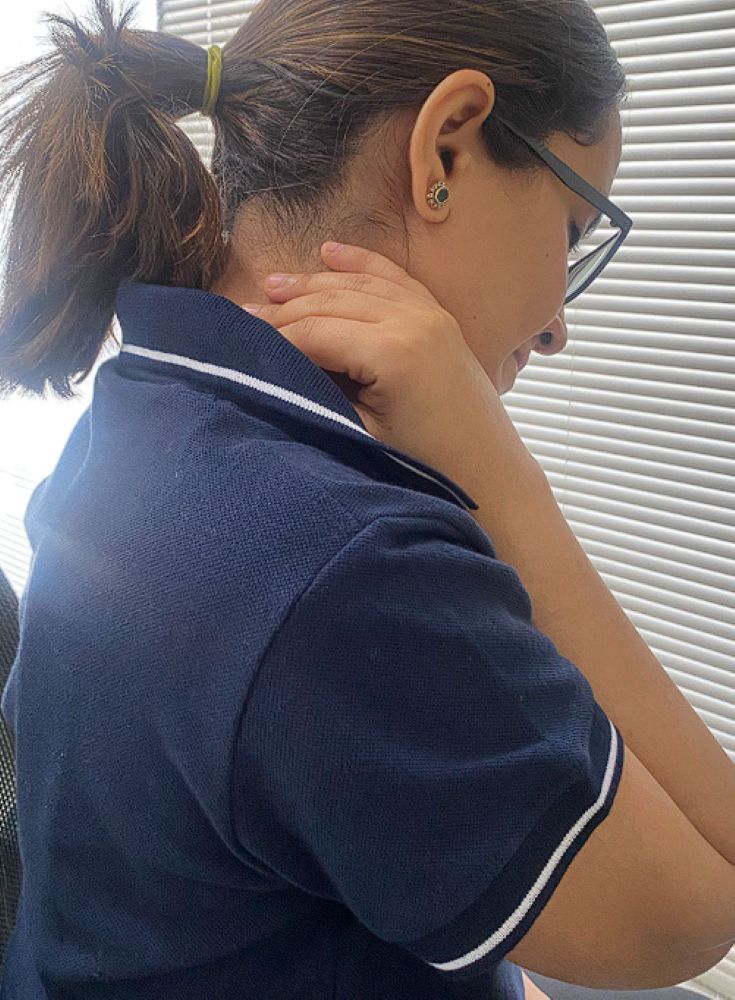
Forward head posture (FHP) is not simply about how you look. It is a structural shift in how load is distributed across the spine.
In a neutral spine, the weight of the head is balanced evenly across the cervical vertebrae. The moment the head drifts forward, that balance changes. The lower cervical spine moves into excessive flexion. The upper cervical spine compensates by extending. The muscles at the back of the neck work continuously to prevent the head from falling further forward.
Over time, this sustained load strains the posterior neck muscles, weakens the anterior ones, gradually stretches the joint capsules and ligaments, and puts abnormal compressive force on the disc spaces. Research also shows that FHP impairs proprioception, meaning the body loses accuracy in sensing where the head is in space.
The result is not just neck pain. It is a system that has reorganised itself around a faulty position.
It is more widespread than most people realise
A systematic review published in Current Reviews in Musculoskeletal Medicine identified FHP as the most common cervical postural fault seen across populations. A meta-analysis confirmed that adults with neck pain showed significantly more FHP than those without symptoms.
Research involving young IT professionals found measurable forward head posture and mild cervical disability even in people in their early thirties with no history of injury. The position correlated directly with cumulative screen time, not age or physical condition.
FHP is not a consequence of getting older. It is a consequence of how most people spend their working hours.
Where the problem spreads
Forward head posture does not stay in the neck. Because the spine functions as a connected system, a shift at the top creates a chain of adjustments below.
When the head moves forward, the thoracic spine often rounds to compensate, which flattens the natural curve of the upper back. The shoulder blades shift out of position. The chest muscles tighten and the muscles between the shoulder blades lengthen and weaken. Breathing mechanics change. Research has shown that sustained poor posture can measurably reduce lung capacity. Balance and proprioception are also affected.
Common presentations that are linked to FHP but often not recognised as such include:
- Persistent headaches, particularly at the base of the skull
- Shoulder pain or tightness that does not resolve with stretching
- Jaw tension or temporomandibular discomfort
- Upper back fatigue after sitting for extended periods
- Reduced range of motion when turning the head
- A sense of tension that returns quickly after massage or manual treatment
Why stretching alone does not fix it
The instinct when dealing with FHP is to stretch the neck, roll the shoulders back, and strengthen the upper back. These are reasonable starting points. They are not sufficient on their own.
FHP develops over years of repeated posture loading. By the time it produces symptoms, several things have happened simultaneously. Joints in the cervical and thoracic spine have lost glide. Soft tissue has adapted around the new position. The neuromuscular system has learned to treat the forward position as normal. The deep stabilising muscles of the neck have weakened and the superficial muscles have taken over.
Addressing this requires more than exercise. It requires restoring mobility in the restricted joints, retraining the neuromuscular system to support a new position, and rebuilding the deep muscle function that has been lost. Without all three, the position reverts.
What needs to be restored
- Joint mobility in the cervical and thoracic spine Restricted joint glide at specific segments must be addressed before retraining can hold. The body will not adopt a new position if the joints cannot move into it.
- Scapular position and thoracic extension The upper back needs to move freely and the shoulder blades need to sit correctly for the head to find its natural position over the shoulders. This is often where the mechanical foundation of FHP sits.
- Deep neck flexor activation and CoreFirst® alignment The deep muscles at the front of the neck are the primary stabilisers of the cervical spine. In FHP they are consistently inhibited. Reactivating them, alongside CoreFirst® postural strategies, is what allows the corrected position to become automatic rather than effortful.
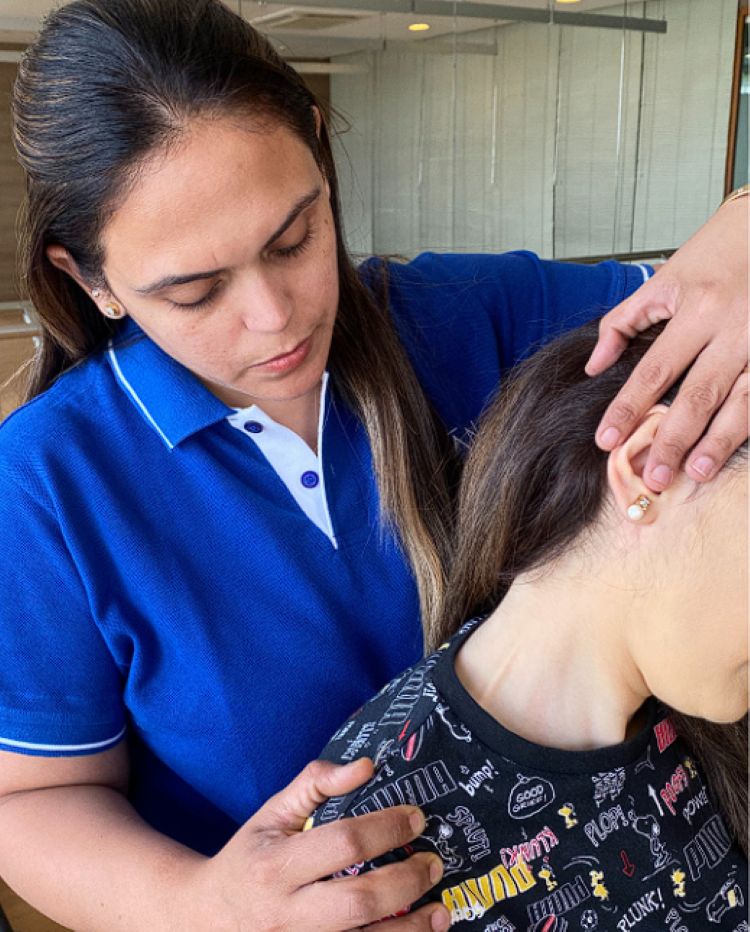
The role of FUNCTIONAL MANUAL THERAPY®
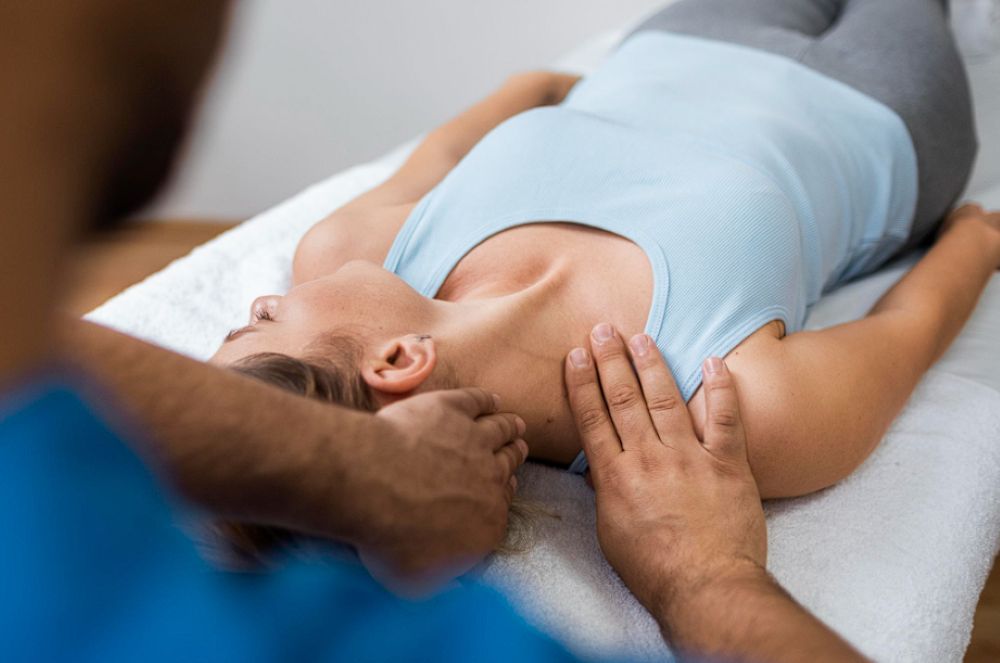
FUNCTIONAL MANUAL THERAPY® (FMT™) is the foundation of how VARDĀN approaches FHP. It allows the therapist to identify exactly where joint restriction exists : in the cervical spine, the upper thoracic spine, the ribcage and restore glide at those specific segments. When mobility returns, the neuromuscular system has the mechanical freedom to adopt and sustain a corrected position.
FMT™ also addresses the soft tissue changes that accumulate with long-standing FHP, shortened suboccipital muscles, restricted fascia, and ligament stiffness, without which postural retraining remains superficial.
The role of CoreFirst®
CoreFirst® addresses the second part of the problem. Once mobility is restored, the body needs to learn a new default. CoreFirst works through breath, alignment, and proprioceptive training to establish an efficient resting posture, for example ribs over pelvis, head balanced over the shoulders. without requiring conscious effort to maintain it.
For people who sit at a desk for extended periods, this transition from effortful correction to automatic alignment is what makes the difference between short term relief and sustained change.
Fast reference: what you feel, what it often means, first focus
| What you experience | What it often means | Initial focus at VARDĀN |
|---|---|---|
| Persistent headache at the base of the skull | Upper cervical compression, suboccipital muscle overload | FMT™ to restore upper cervical mobility |
| Neck stiffness that returns after treatment | Joint restriction not yet addressed, position not yet retrained | Targeted joint mobilisation with CoreFirst® retraining |
| Shoulder blade ache after desk work | Thoracic restriction and scapular instability secondary to FHP | Restore thoracic mobility, retrain scapular position |
| Jaw tension or clicking | FHP altering bite mechanics and hyoid muscle tension | Address cervical alignment and deep neck flexor activation |
| Fatigue after short periods of sitting | Postural muscles working harder than they should | CoreFirst® alignment and endurance work |
Two adjustments you can apply today
- Adjust where you look, not just how you sit. Most FHP is driven by screen position. Raise your screen so the top of the display is at eye level. Posture changes follow the eyes. If the eyes are level, the head tends to follow.
- Reset with a chin tuck, not a shoulder roll A gentle chin tuck — drawing the head straight back rather than dropping the chin — reactivates the deep neck flexors and briefly decompresses the cervical joints. Ten repetitions, held for two seconds each, done two to three times during the workday, is more effective than intermittent shoulder rolling.
What progress looks like in two weeks
- Days 1 to 4 FMT™ to restore joint glide in the upper and mid cervical spine and the upper thoracic region. Identify and address the primary mobility restrictions driving the forward position. Begin CoreFirst® breath and alignment strategies in sitting and standing.
- Days 5 to 10 Reintroduce deep neck flexor activation and scapular control exercises. Reinforce CoreFirst® posture in the positions where FHP is most habitual — at a desk, during prolonged sitting, and during transitions.
- Days 11 to 14 Progress endurance and load. Assess how the position holds under the conditions that originally produced the problem. Adjust the plan based on response.
Book an assessment at VARDĀN
If you have persistent neck tension, recurring headaches, shoulder stiffness, or a posture that feels increasingly difficult to correct — the problem is most likely mechanical and neuromuscular, not a lack of effort or awareness.
A comprehensive assessment at VARDĀN will identify where mobility is restricted, which muscles have stopped doing their job, and what the correct sequence of restoration looks like for your spine.
Request an appointment for a Functional Manual Therapy® session or a CoreFirst® Movement Assessment at VARDĀN, Lajpat Nagar, New Delhi.
Call us today at +91 011 43580720-22 / 9810306730
📅 Book your root-cause consultation at www.vardan.in
📍 Visit our advanced physiotherapy clinic in Delhi in Lajpat Nagar
Frequently Asked Questions
Core exercises build strength in static positions. They do not retrain timing. The pain is a pattern problem, not an effort problem.
No. It is relevant for anyone whose performance is inconsistent, whose training has plateaued, or who wants to reduce injury risk under higher loads.