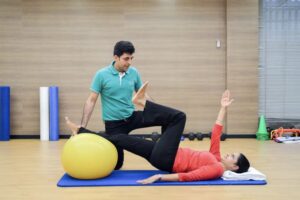
You may be strong. You may exercise regularly. You may run, swim, lift weights, play a sport, or complete demanding workouts without difficulty.
But does that automatically mean your body is moving efficiently?
Not necessarily.
The Institute of Physical Art (IPA), which developed Functional Manual Therapy® (FMT™), describes functional efficiency as having sufficient mechanical capacity, neuromuscular function, and motor control to provide the body with different movement strategies for performing a task. In other words, efficient movement is not simply about how much strength or endurance you have. It is also about how effectively your body uses what it has.
This distinction can explain why someone who appears extremely fit can still experience recurring tightness, restricted movement, repeated injuries, or discomfort during certain activities.
The Common Misconception: Fitness Equals Efficient Movement
Fitness and movement efficiency are related, but they are not the same thing.
Fitness usually describes physical capacities such as:
- Strength
- Cardiovascular endurance
- Muscular endurance
- Power
- Speed
- Flexibility
Biomechanical efficiency looks at something different: how the body coordinates movement and distributes forces while performing a task.
For example, you may have strong legs but limited ankle mobility. You may have powerful shoulders but inadequate thoracic rotation. You may have excellent cardiovascular fitness but poor trunk control.
Your body can often compensate for these limitations. In fact, a fit person may be particularly good at compensating because strength and conditioning allow the body to find another way to complete the task.
The movement gets done. But it may not be getting done efficiently.
What Does Biomechanical Efficiency Actually Mean?
Efficient movement requires multiple systems to work together.
The Functional Manual Therapy® model looks at three interconnected components:
Mechanical capacity: Do the joints, muscles, soft tissues and other structures have the mobility required for the movement?
Neuromuscular function: Can the appropriate muscles activate with sufficient strength, endurance, timing and coordination?
Motor control: Can the nervous system organise those components into a coordinated movement strategy?
IPA describes efficient balance and movement as requiring dynamic interaction between these mechanical, neuromuscular, and motor-control systems.
If one component is limited, another part of the body may begin doing more than its share.
That is where compensation begins.
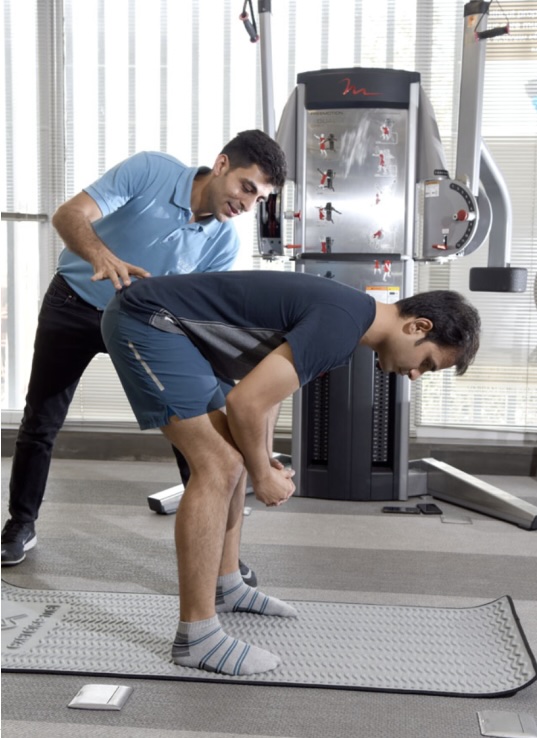
A Simple Example: The Squat
Consider someone who exercises regularly and can perform a heavy squat.
From a fitness perspective, that person may demonstrate considerable strength.
But now look at the movement itself.
Does the ankle have enough mobility?
Are the hips moving freely?
Can the pelvis and trunk remain controlled?
Is weight distributed effectively through both legs?
If ankle mobility is restricted, the foot may compensate. The knee may change position. The hip or trunk may alter its strategy to allow the person to reach the bottom of the squat.
The individual may still lift the weight successfully.
The question is not simply, “Can you do it?”
The better question is, “How is your body doing it?”
Why Fit People Can Still Develop Pain or Recurring Injuries
The human body is remarkably adaptable.
When one area does not contribute sufficiently, another area can often compensate. Initially, this may cause no obvious problem.
Over time, however, repeatedly using the same compensation strategy can alter how forces are distributed through the body.
You might notice:
- The same muscle becoming tight after every workout
- Repeated strains or sprains
- One side feeling stronger or more mobile than the other
- Difficulty with rotation despite good overall fitness
- Recurring back, knee, shoulder, or hip discomfort
- A movement that always feels awkward on one side
- Performance plateauing despite increased training
These signs do not automatically indicate a serious problem. But they can be reasons to examine movement quality, rather than simply adding more strength or flexibility work.
Why Mobility Alone Is Not the Answer
When something feels tight, stretching is often the first response.
But improving range of motion is only one part of efficient movement.
Once mobility is available, the body must be able to control that new range.
This is why the FMT™ approach does not stop at mechanical mobility. Functional Mobilization™ combines mobility work with active and resisted movement, while incorporating neuromuscular function and motor control into the newly available range.
A joint that moves further but cannot be controlled effectively does not necessarily produce better function.
What Restoring Movement Efficiency Actually Requires
1. Restore Mechanical Capacity
First, identify restrictions that may be preventing efficient movement.
These could involve joints, muscles, fascia, soft tissues, or other structures that influence mobility.
2. Retrain Neuromuscular Function and Motor Control
Once movement is available, the body needs to learn how to use it.
This means improving muscle activation, coordination, stability, proprioception, and control.
3. Integrate It into Real Movement
The final step is translating those improvements into walking, running, lifting, playing sport, working, or whatever activity matters to the individual.
The goal is not simply more movement.
It is better-organised movement.
What Restoring Function Actually Requires
1. Restore Mobility
The foot, ankle, calf, knee, hip, and surrounding tissues need enough mobility to allow efficient movement. If restrictions are present, they should be addressed so the body has better options for distributing load.
2. Retrain Control
The next step is improving balance, single-leg control, weight transfer, and neuromuscular coordination. The objective is to help the entire lower limb manage force rather than relying excessively on the Achilles tendon.
3. Build Tendon Capacity
The tendon must gradually become capable of handling the demands of running, jumping, and sport. Loading is progressed according to symptoms, movement quality, and athletic requirements rather than simply returning immediately to previous training levels.
Where Functional Manual Therapy® Fits In
FMT™ evaluates the body as an interconnected movement system rather than looking only at the area where symptoms appear.
The assessment considers posture, functional movement patterns, mechanical capacity, neuromuscular function, motor control, and how different regions interact during a task.
This can help identify whether a restriction in one region is influencing movement elsewhere.
For an athlete, this might mean examining how hip mobility influences trunk rotation.
For a runner, it could involve how the foot, ankle, knee, pelvis, and trunk coordinate with each stride.
For someone who trains in the gym, it may involve understanding why one side consistently compensates during a squat, press, or deadlift.
The objective is not merely to address the symptom. It is to improve the way the entire system performs the movement.
Where CoreFirst® Comes In
Efficient movement also depends on the body’s ability to create stability before and during movement.
The IPA’s CoreFirst® approach emphasises efficient posture and movement strategies, including Automatic Core Engagement (ACE). Its neuromuscular training framework focuses on proprioception, kinesthetic awareness, motor control, and coordinated movement.
This becomes particularly important when speed, resistance, or sporting demands increase.
Strength without adequate control can simply reinforce an existing compensation.
Strength built on efficient movement provides a better foundation for performance.
Fitness vs Biomechanical Efficiency: A Quick Comparison
| Being Fit | Being Biomechanically Efficient |
|---|---|
| Strong muscles | Coordinated muscle activation |
| Good endurance | Efficient energy use during movement |
| Ability to perform an exercise | Ability to perform it with effective mechanics |
| Good flexibility | Appropriate mobility with control |
| High training capacity | Effective load distribution |
| Greater power | Ability to transfer force efficiently |
Ideally, you want both.
Two Things You Can Start Noticing
1. Compare sides, not just performance.
When you squat, lunge, rotate, reach, or balance, notice whether one side moves differently from the other.
2. Pay attention to recurring tightness.
If the same area repeatedly becomes stiff despite stretching, consider whether another region may be contributing to the way you move.
What Progress Should Look Like
Improving biomechanical efficiency is not necessarily about achieving extreme flexibility or perfect-looking movement.
Progress may mean:
- Less effort during familiar activities
- Smoother movement
- Better control
- More balanced loading
- Greater confidence through different ranges
- Fewer recurring restrictions
- Improved ability to generate and transfer force during sport
The IPA’s FMT™ clinical reasoning model describes movement efficiency in terms that include movement being smooth, successful, and placing less unnecessary stress on joints and muscles.
That is an important distinction.
Being fit tells you what your body is capable of doing. Biomechanical efficiency tells you how effectively your body is doing it.
Are You Fit but Still Compensating?
If you train regularly but continue experiencing recurring tightness, restricted movement, repeated discomfort, or differences between sides, simply becoming stronger may not address the entire problem.
A Functional Manual Therapy® assessment at VARDĀN can evaluate your mechanical capacity, neuromuscular function, motor control, and overall movement strategy to identify where efficiency may be getting lost.
Book your movement assessment at VARDĀN and understand how your body is really moving.
Call us today at +91 011 43580720-22 / 9810306730
📅 Book your root-cause consultation at www.vardan.in
📍 Visit our advanced physiotherapy clinic in Delhi in Lajpat Nagar