What the Data Tells Us
Sports injuries are not always caused by one sudden incident.
A systematic review involving 24,704 athletes found that the period prevalence of overuse injuries was 42% among athletes in individual sports and 33% among those participating in team sports. (PubMed)
This is important because overuse problems often develop gradually.
An athlete may continue running, swimming, lifting, playing golf, or competing while the body quietly changes the way it moves. A stiff ankle may change the way the knee absorbs load. Limited hip mobility may make the lower back rotate more. Reduced shoulder mobility may cause the trunk or neck to compensate.
The athlete is still performing. But the movement strategy has changed.
This is where movement restoration becomes important.
The Common Misconception: No Pain Means Full Recovery
Athletes often judge recovery by one question:
“Does it still hurt?”
Pain settling is certainly important, but it does not always mean normal movement has returned.
After an injury, the body naturally protects the affected area. You may shift more weight onto the other leg, reduce your stride, avoid a certain range, or use another joint to complete the movement.
These adaptations are useful in the early stages of recovery.
The problem begins when the injury heals but the compensation remains.
An athlete may return to training with good strength and no significant pain while still moving differently.
What Movement Restoration Actually Means
Movement restoration is not simply about getting an injured joint moving again.
It means restoring the body’s ability to perform the required activity with appropriate:
- Mobility
- Stability
- Strength
- Neuromuscular control
- Coordination
- Load distribution
- Movement timing
These elements need to work together.
For example, restoring ankle mobility after an injury is useful. But the athlete must also regain balance, control, strength, and the ability to accept load through that ankle during running, jumping, or changing direction.
That is the difference between restoring a body part and restoring a movement.
Why Compensation Matters
The human body is very good at finding another way to complete a task.
Imagine a runner with restricted movement at the right ankle.
The body still needs to move forward, so the knee, hip, pelvis, or opposite leg may begin contributing differently.
The runner may not notice this immediately.
Over hundreds or thousands of repeated strides, however, the altered movement pattern can change where load is being absorbed.
The same principle applies across sports.
A swimmer with restricted shoulder or thoracic mobility may compensate through another region.
A golfer with limited hip rotation may ask more from the lumbar spine.
A badminton player with reduced ankle control may change the way the knee manages landing and direction changes.
The painful area is therefore not always the only area that needs attention.
How FMT™ Looks at Athletic Movement
Functional Manual Therapy® looks at the body as an interconnected movement system.
Rather than focusing only on the painful or previously injured area, the assessment examines how different regions contribute to the athlete’s movement.
At VARDĀN, FMT™ considers joint mechanics, soft tissue mobility, neuromuscular control, and movement patterns when identifying factors that may be affecting function.
For an athlete, this may involve looking at:
- How the foot accepts load
- Whether the ankle has sufficient mobility
- How the knee tracks during movement
- Whether the hip can generate and control rotation
- How the pelvis and trunk provide stability
- Whether the shoulders and spine have the mobility required for the sport
- How the body coordinates these regions during the actual activity
The objective is to understand where the movement is breaking down and why.
What Restoring Athletic Movement Requires
1. Restore Mobility
The athlete first needs sufficient movement at the joints and soft tissues involved in the activity.
If a joint cannot access the range required for the sport, another region may compensate.
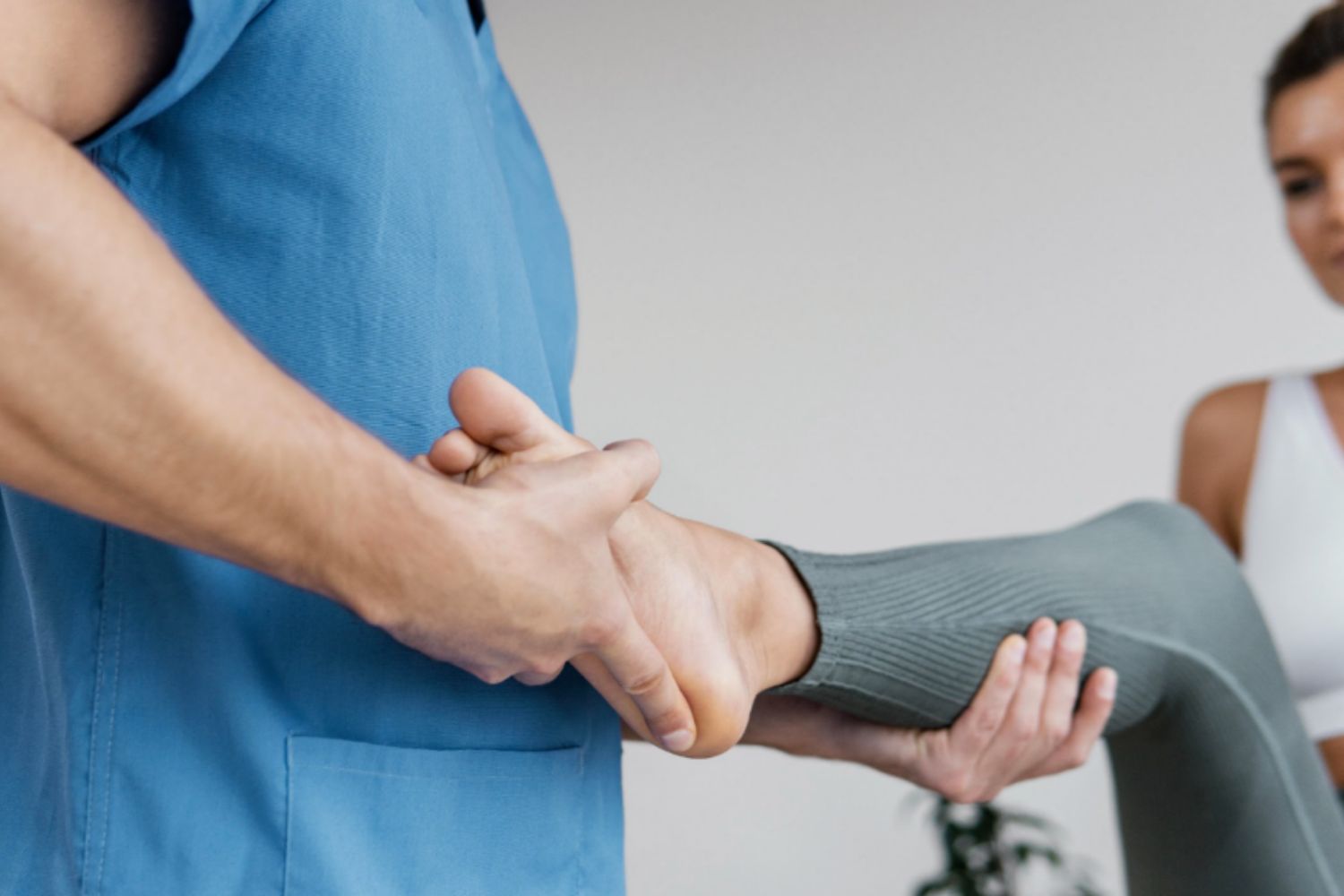
FMT™ uses specific manual techniques to address restrictions and improve available movement.
2. Retrain Neuromuscular Control
Restoring range is only the beginning.
The body must learn how to control the available movement.
This includes balance, coordination, muscle activation, stability, proprioception, and timing.
An ankle that has regained mobility, for example, still needs to respond quickly when the athlete lands, accelerates, or changes direction.
3. Return the Movement to Sport
Finally, the improved mobility and control need to work during the athlete’s actual activity.
For a golfer, this may involve rotation and weight transfer.
For a swimmer, it may involve shoulder mobility combined with trunk control.
For a runner, it may mean restoring efficient loading through the foot, ankle, knee, hip, and pelvis.
For a badminton player, it could involve lunging, landing, deceleration, and rapid changes in direction.
This is where rehabilitation begins to reconnect with performance.
The Role of FMT™
FMT™ brings these stages together.
It can help restore joint and soft tissue mobility while also addressing neuromuscular function and movement patterns. The aim is not simply to make an area feel looser, but to help the body use the restored movement during functional activity.
This is particularly relevant for athletes because sporting movements rarely involve one joint working independently.
Running, swimming, throwing, swinging, jumping, and changing direction all require different areas of the body to work together.
The Role of CoreFirst®
Once mobility is available, the body also needs stability.
CoreFirst® focuses on how the trunk provides support while the arms and legs move.
This matters because force needs to travel efficiently through the body during athletic activity.
A golfer needs to transfer force from the ground through the legs and trunk into the club.
A swimmer needs trunk control while the arms and legs generate propulsion.
A runner needs stability through the pelvis and trunk as force moves through each leg.
FMT™ can help restore the movement options the body needs, while CoreFirst® helps integrate those changes into a more controlled movement strategy. VARDĀN describes CoreFirst® as focusing on posture, alignment, coordinated movement, and automatic support strategies.
Movement Restoration at a Glance
| What the Athlete May Notice | What May Need Attention |
|---|---|
| Repeated tightness | Mobility and load distribution |
| One side feels different | Movement symmetry and control |
| Recurring strains or sprains | Mobility, stability and neuromuscular response |
| Difficulty changing direction | Balance and deceleration control |
| Lower back tightness during sport | Hip, trunk and movement strategy |
| Reduced power after injury | Force generation and transfer |
| Technique changes with fatigue | Movement control under load |
These signs do not automatically indicate an injury. They can, however, provide useful information about how the body is managing the demands of sport.
Two Things Athletes Can Start Noticing
1. Pay attention to repeated problems.
If the same muscle repeatedly feels tight or the same joint becomes uncomfortable after training, do not look only at that area. Notice what the rest of the body is doing during the movement.
2. Watch what happens under fatigue.
Compensation often becomes easier to see when the body gets tired. Notice whether your stride changes, one side starts doing more work, or your technique becomes harder to maintain.
These observations can help identify when movement quality begins to change.
What Does Progress Look Like?
Movement restoration is not measured only by the absence of pain.
Progress may also mean:
- More comfortable movement
- Better balance between sides
- Improved mobility
- Greater control through the available range
- Better load tolerance
- Smoother sport-specific movement
- Less dependence on compensation
- Greater confidence returning to training
The exact progression will depend on the injury, the athlete, and the physical demands of the sport.
Recovery Should Restore the Athlete, Not Just the Injured Area
Getting an athlete back to sport involves more than waiting for pain to disappear.
The body needs to regain the mobility, control, coordination, and movement strategies required for the activity.
FMT™ helps identify restrictions and compensation patterns that may continue after an injury and works towards restoring more efficient movement. At VARDĀN, this approach is also used to support sports and recreational performance.
If you have returned to training but your movement still feels different, book a Functional Manual Therapy® assessment at VARDĀN.
Call us today at +91 011 43580720-22 / 9810306730
📅 Book your root-cause consultation at www.vardan.in
📍 Visit our advanced physiotherapy clinic in Delhi in Lajpat Nagar