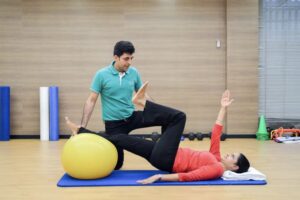
“Initially even with FMT the pain would return, but slowly I could stand longer and take more shots… During and after my 12 sessions he gave me very specific exercises for particular areas to gradually strengthen my muscles and improve my posture.”
— Suma Shirur, Olympian Shooter
Suma Shirur’s experience highlights an important part of recovery. Reducing pain is one step. Restoring the movement, control, strength, and physical capacity required to return to an activity is another.
This is where Functional Manual Therapy® and CoreFirst® can work together. FMT™ addresses restrictions that may be limiting movement, while CoreFirst® helps the body use that movement with better stability and control.
What the Research Has Been Saying
Movement performance depends on more than muscle strength.
Research into sports rehabilitation consistently shows the importance of mobility, neuromuscular control, balance, coordination, and progressive loading when returning to physical activity after injury.
An athlete may regain strength but still move differently. A joint may have adequate range, yet the body may not control that range effectively. Pain may disappear while the compensation developed during the injury remains.
This is why rehabilitation needs to progress beyond symptom relief.
The goal is to restore the body’s ability to move efficiently and then prepare it for the demands of everyday activity, exercise, or sport.
The Common Misconception
A common assumption is that once pain reduces and strength returns, the body is ready to perform normally again.
That is not always the case.
During pain or injury, the body naturally finds ways to protect itself. You may shift weight to one side, reduce movement at a joint, change your posture, or ask another area to work harder.
These compensations can help temporarily.
But if they continue after the original problem improves, they can affect movement efficiency.
Being pain-free is important. It does not automatically mean the body has returned to its previous movement strategy.
A Case That Explains It Clearly
Suma Shirur’s experience is a good example.
Her back pain became particularly noticeable when she returned to her shooting position. She could feel better during normal activities, but the symptoms returned when she picked up her rifle and trained.
That distinction matters.
Shooting requires her to manage a 5.5 kg rifle while maintaining a demanding position for prolonged periods. Her rehabilitation therefore needed to address more than back pain. She describes gradually being able to stand longer and take more shots while working on specific strengthening and posture.
The goal was not simply to feel better at rest.
It was to function better during the activity that mattered to her.
What the Problem Actually Is
Movement restrictions can develop for many reasons.
A joint may become stiff after an injury. Soft tissues may lose mobility. Muscles may not activate effectively. Pain may cause the nervous system to change how a movement is performed.
The body then adapts.
For example, limited hip mobility may cause greater movement through the lower back. Restricted ankle movement may change how the knee manages load. Poor trunk control may make the shoulders or legs work harder during an activity.
The body can often continue performing despite these restrictions.
The problem is that it may be using a less efficient strategy to do so.
How It Actually Works
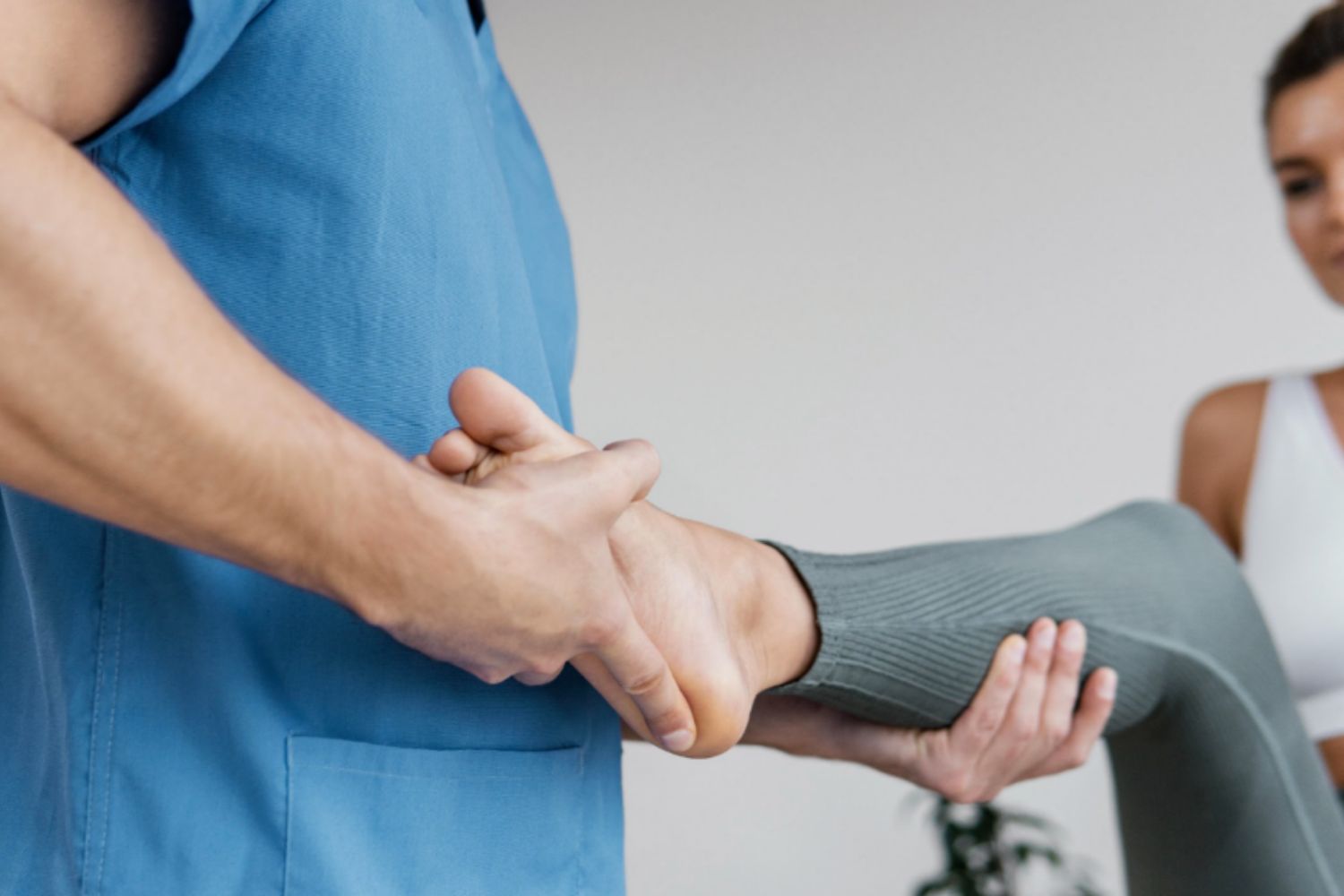
Efficient movement requires several systems to work together:
- Adequate joint mobility
- Soft tissue mobility
- Appropriate muscle activation
- Stability
- Balance
- Neuromuscular control
- Coordination
- Efficient force transfer
Consider a simple overhead movement.
The shoulder needs sufficient mobility, but the shoulder does not work alone. The upper back needs to move. The shoulder blade needs to contribute. The trunk needs to provide stability.
If one part is restricted, another area may compensate.
The same principle applies to walking, running, lifting, swimming, golf, badminton, or almost any physical activity.
Restoring one restricted area is therefore only the beginning.
The body must also learn how to use the available movement.
Why This Matters in Daily Life and Performance
The difference becomes more obvious as physical demands increase.
You may be able to walk comfortably but experience difficulty while running.
You may lift a light object without a problem but lose control with heavier resistance.
A golfer may feel comfortable during daily activities but notice restriction during rotation.
A swimmer may have no shoulder discomfort at rest but struggle after repeated strokes.
This happens because performance places greater demands on mobility, stability, coordination, and force transfer.
The body has less room to compensate when speed, resistance, repetition, or fatigue increases.
That is why movement restoration should prepare the person not only for everyday function but also for the activities they want to return to.
Early Signs That Movement Restriction May Be Affecting Performance
Look for these patterns:
- One side consistently feels tighter than the other
- The same muscle becomes stiff after every workout
- Rotation is easier in one direction
- Technique changes as you become tired
- Balance decreases when speed increases
- Your lower back or shoulders work harder than expected
- You have strength but lack control during complex movements
- You are pain-free but still do not move as you did before an injury
These signs do not necessarily mean something is injured.
They may indicate that the body is compensating for a restriction or control issue.
What Restoring It Actually Requires
1. Restore Mobility
The first step is identifying what is restricting movement.
The limitation may involve a joint, muscle, fascia, or another structure affecting the movement chain.
FMT™ works on restoring the mobility required for the activity.
2. Retrain Control
More mobility is useful only if the body can control it.
Once movement becomes available, neuromuscular control, balance, coordination, and stability need to be retrained.
This helps the body develop a more effective strategy rather than returning to the old compensation.
3. Build Capacity and Performance
The final stage is gradually increasing the physical demands placed on the body.
This may involve more resistance, greater speed, longer duration, repeated movement, or sport-specific tasks.
The goal is to make sure improved movement continues when the activity becomes more demanding.
The Role of Functional Manual Therapy®
FMT™ begins by understanding why movement is restricted.
Rather than looking only at the area where symptoms appear, the Functional Manual Therapy team assesses how different parts of the body are contributing to the movement.
For example, lower back discomfort may involve restrictions in the hips or pelvis. Knee symptoms may be influenced by the ankle or hip. Shoulder problems may involve the upper back, rib cage, or trunk.
FMT™ addresses joint and soft tissue restrictions while also considering neuromuscular function and movement control.
The objective is not simply to create more range.
It is to create movement that the body can use effectively.
The Role of CoreFirst®
Once movement is available, the body needs a stable base from which to use it.
CoreFirst® focuses on posture, trunk control, and Automatic Core Engagement.
The core should not need to be consciously tightened before every movement. It needs to respond naturally as the arms and legs move.
This becomes especially important during activities involving resistance, speed, rotation, or changes in direction.
For example, a golfer needs trunk stability while the body rotates.
A runner needs pelvic and trunk control with every stride.
A badminton player needs stability while lunging, landing, and changing direction.
A swimmer needs the trunk to connect movement between the upper and lower body.
CoreFirst® helps integrate restored mobility into these functional movement patterns.
How FMT™ and CoreFirst® Work Together
FMT™ and CoreFirst® address different but connected parts of movement restoration.
FMT™ helps create the mobility required for movement.
CoreFirst® helps the body control and use that mobility effectively.
Together, the progression looks like this:
Restriction → Mobility → Control → Integration → Performance
For example, an athlete may have limited hip rotation.
FMT™ can address restrictions that are preventing the hip from moving adequately.
Once the movement is available, CoreFirst® can help integrate that range with trunk stability and coordinated movement.
The athlete can then progressively use the improved strategy during running, lifting, swinging, or another sport-specific activity.
Fast Reference: What You Feel, What It May Mean, Initial Focus at VARDĀN
| What you experience | What it may indicate | Initial focus at VARDĀN |
|---|---|---|
| Repeated stiffness | Mobility restriction | Restore available movement |
| One side works harder | Compensation pattern | Improve movement symmetry |
| Good strength but poor control | Neuromuscular coordination issue | Retrain stability and control |
| Pain returns during sport | Activity-specific movement problem | Assess the complete movement |
| Technique changes with fatigue | Reduced control under load | Build movement capacity |
| Difficulty generating power | Inefficient force transfer | Integrate mobility with trunk control |
Two Adjustments You Can Apply Today
1. Pay Attention to Differences Between Sides
During a squat, lunge, rotation, or overhead movement, notice whether one side feels easier than the other.
Do not force the restricted side. Simply recognising the difference can help you understand where your movement may need attention.
2. Watch What Happens When You Get Tired
Fatigue can reveal movement patterns that are difficult to notice at the beginning of an activity.
If your posture changes, one side starts doing more work, or technique becomes difficult to maintain, it may indicate that movement control needs improvement.
What Progress Can Look Like in Two Weeks
Days 1 to 4
Assess mobility, posture, movement patterns, and compensation. Begin addressing mechanical restrictions that may be limiting movement.
Days 5 to 10
Integrate the available mobility with neuromuscular control, stability, and Automatic Core Engagement.
Days 11 to 14
Gradually introduce more demanding functional or sport-specific movements while assessing how well the body maintains control.
The exact timeline varies according to the individual’s condition, activity level, and physical demands. Two weeks should therefore be viewed as an early progression rather than a fixed recovery period.
From Better Movement to Better Performance
Performance does not begin with speed, power, or heavier resistance.
It begins with the ability to move well.
FMT™ helps address restrictions that may be limiting movement. CoreFirst® helps the body control and integrate that movement as physical demands increase.
Together, they provide a progression from restoring movement to preparing the body for the activities that matter to you.
Book an Assessment at VARDĀN
If you are pain-free but still feel restricted, compensate during movement, or cannot perform at the level you expect, it may be useful to understand what is limiting you.
A comprehensive assessment at VARDĀN can identify restrictions in mobility, stability, neuromuscular control, and movement patterns before building towards more demanding activity.
Request an appointment for a Functional Manual Therapy® session or a CoreFirst® Movement Assessment at VARDĀN, Lajpat Nagar, New Delhi.
Visit vardan.in | Call +91 011 43580720-22 | Write to vardan@timesgroup.com
Call us today at +91 011 43580720-22 / 9810306730
📅 Book your root-cause consultation at www.vardan.in
📍 Visit our advanced physiotherapy clinic in Delhi in Lajpat Nagar