The Anatomy of Sports Injuries: A Brief Overview
- Bones & Joints: Shoulder joint, elbow, wrist, lumbar spine (lower back), hips, knees.
- Muscles : Rotator cuff (stabilizes shoulders), core stabilizers (abs, obliques, spine muscles), scapular muscles (control shoulder blade).
- Tendons: Forearm extensors (elbow/wrist), patellar & hip tendons.
- Overuse injuries: These happen gradually from repeated motions and can cause tendon pain, swelling, or irritation.
- Acute injuries: These are sudden injuries like sprains or strains from a specific movement or accident.

Sport-Wise Breakdown
Tennis
- Key body parts: Elbow (outside), shoulder (rotator cuff), wrist, lower back.
- Common injuries: Tennis elbow, rotator cuff tears, wrist sprains.
- Why they happen: Repeating forehand and backhand movements strain tendons around the elbow and wrist. Stiffness in the back forces the arm to work harder.
- Prevention: Strengthen forearm muscles with eccentric exercises, use the right grip size on your racket, and improve shoulder and upper back stability.
Golf
- Key body parts: Lower spine, elbows, shoulders, knees.
- Common injuries: Lower back pain, golfer’s elbow, knee irritation.
- Why they happen: Rotational force plus poor posture during the swing stresses the back, elbows, and knees.
- Prevention: Build core strength, work on hip flexibility, and focus on good swing mechanics.
Swimming
- Key body parts: Shoulders (rotator cuff and shoulder blade muscles), knees (especially breaststroke), lower back.
- Common injuries: Swimmer’s shoulder, knee strain from breaststroke, back strain from excessive arching.
- Why they happen: Overhead motions irritate shoulders; repetitive kicking stresses knees; bad posture affects the lower back.
- Prevention: Strengthen shoulder stabilizers off the pool, stretch hip muscles, and refine swim technique for better efficiency.
| Sport | Key Stress Areas | Common Injuries | Why They Happen | Prevention Focus |
|---|---|---|---|---|
| Tennis | Elbow, shoulder, wrist, lower back | Tennis elbow, rotator cuff strains, wrist sprains | Repetitive strokes overload tendons, stiff spine compensation | Forearm strength, correct grip, shoulder stability |
| Golf | Lower back, elbows, knees, shoulders | Back pain, golfer’s elbow, knee strain | Rotation + poor posture stress joints | Core strength, hip mobility, swing technique |
| Swimming | Shoulders, knees, lower back | Swimmer’s shoulder, breaststroker’s knee, lumbar strain | Overhead strokes & repetitive kicks | Shoulder stabilizers, hip stretches, technique drills |

Recovery and Professional Guidance
- Rest from activities that cause pain.
- Ice the area to reduce swelling.
- Compression with bandages prevents excess swelling.
- Elevation keeps the injured part raised to lower inflammation.
Functional Manual Therapy® (FMT™): A Smarter Approach to Recovery
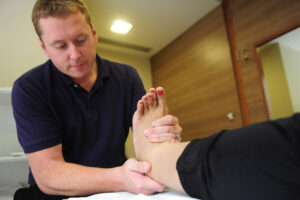
When injuries do happen, traditional rest or stretching often isn’t enough. This is where Functional Manual Therapy® (FMT™) comes in a specialized, hands-on physiotherapy approach that combines manual techniques, movement re-education, and strength training.
How FMT Works
Hands on Therapy : Therapists use precise hands-on techniques to release joint restrictions, muscle tightness, and fascial adhesions.
This restores normal mobility in the spine, shoulders, and hips — areas heavily stressed in tennis, golf, and swimming.
Neuromuscular Re-Education : Injuries often cause faulty movement patterns (e.g., overusing the wrist in tennis, rotating too much from the lower back in golf, or poor shoulder blade control in swimming).
FMT™ retrains your nervous system for more efficient, pain-free movements.
Functional Strength Training : Instead of isolated exercises, FMT™ emphasizes sport-specific movements.
Example: Core rotation drills for golf swings, scapular stability for swimming strokes, eccentric loading for tennis forearm tendons.
Benefits of FMT for Athletes
- Faster Recovery: Reduces pain and restores mobility quicker than passive treatments.
- Injury Prevention: Corrects biomechanical faults before they cause overuse injuries.
- Performance Boost: Optimizes joint alignment and muscle coordination, improving efficiency in strokes, swings, and kicks.
- Holistic Care: Doesn’t just treat the pain area but looks at the whole kinetic chain (shoulders–spine–hips connection).
Case study: three sports, one solution
Two months before a corporate tournament, Arjun, 36, cranked up tennis, weekend golf and pre-work pool sessions. By week three he felt elbow pain on backhands, a tight low back after the range and a front-of-shoulder ache during freestyle. Rest helped for a bit, then the cycle returned the moment he pushed pace.
At VARDĀN, assessment showed limited mid-back rotation, tight hips and underpowered shoulder-blade control. A focused block of Functional Manual Therapy® (FMT™) freed motion, rewired coordination and added capacity that matched his sports. Arjun went back to full sessions without flare-ups — and left with a plan to stay that way.
One-minute movement screen
- Wall reach: Both arms overhead. Any pinch or side-to-side difference?
- Seated trunk rotation: Turn right and left. Does one side block or feel stiff?
- Single-leg balance: Hold 20 seconds each side. Hip drop or wobble?
- Scapular set: Can you slide shoulder blades down and around ribs without shrugging?

Reset. Rebuild. Return.
Request an Appointment at VARDĀN, Lajpat Nagar, New Delhi for a personalised Functional Manual Therapy® assessment and a sport specific rehab plan.
Call us today at +91 011 43580720-22 / 9810306730
📅 Book your root-cause consultation at www.vardan.in
📍 Visit our advanced physiotherapy clinic in Delhi in Lajpat Nagar
Frequently Asked Questions
Build eccentric forearm strength, fine-tune grip and string tension, improve mid-back rotation and limit sudden spikes in hitting volume.
Warm up fully, alternate clubs to vary load, cap range time before fatigue and train both anti-rotation and rotation strength twice a week.
Rowing patterns, external-rotation work, overhead lifts within a comfortable range and serratus activation with steady breathing.
You tolerate more volume with stable technique, enjoy full comfortable motion and wake up without next-day flare. If symptoms linger, book a movement evaluation to adjust the plan.