Most running injuries are not random. They happen when the body stops moving smoothly. One area stops doing its job, and another area takes too much pressure. That is when pain begins.
At VARDĀN, we don’t just treat where it hurts. We identify why it hurts. Using Functional Manual Therapy® (FMT™), we restore natural joint movement, improve coordination and build strength so your body shares load correctly from foot to core, allowing you to run smoothly, efficiently and without any pain.
A common runner’s problem and how we fixed it
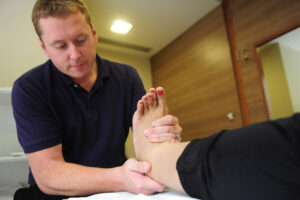
Two weeks after increasing her mileage, Aisha felt burning along her shins by kilometre four and lost form on downhills. New insoles and extra stretching did not help. At VARDĀN, an FMT™ session restored ankle and foot motion.
CoreFirst® cues set ribs over pelvis so the trunk shared the work. We added a small cadence change and steady calf strengthening. By the next Sunday long run, she finished without pain for the first time in months.

Why runners get the same pains again and again
- When the foot, ankle, hip, or thoracic spine lacks smooth glide, every step demands extra effort and the impact rises with each kilometre.
- If timing is off, the deep stabilisers fail to engage and the larger muscles grip to protect you, which leaves movement feeling heavy and inefficient.
- Sudden jumps in hills, speed, or weekly volume load the tissues faster than they can adapt, so irritation builds even when your fitness is improving.
- As fatigue sets in, technique drifts: the stride lengthens, cadence slows, the pelvis starts to wobble, and the foot loses its tripod, which pushes stress up the chain.
Where FMT™ fits in your running week
- Restore mobility with FMT™ for joint and soft tissue glide in the foot, ankle, hip and trunk.
- Re code control with CoreFirst® alignment and breath so the trunk sets before the step.
- Reload durability with targeted strength and drills that carry into running—often supported by Clinical Pilates and sport specific conditioning.
- Prove it in the skill with stride tune ups: a slightly higher cadence, foot strike under the body, relaxed arms, quiet trunk.
The runner’s pain map: three usual suspects
1) Shin splints (medial tibial stress)
What it feels like: a hot line along the inner shin with early run pain that may ease then return.
Common drivers: long stride and low cadence, limited ankle dorsiflexion, weak or tired calves, late trunk set.
FMT™ approach: free talocrural and subtalar glide, ease tibial soft tissue tension, set CoreFirst® alignment, then build calf strength and controlled hops. A small cadence increase often reduces tibial stress immediately.
2) Plantar fasciitis
What it feels like: first steps hurt in the morning; heel or arch aches after runs or long stands.
Common drivers: stiff big toe and midfoot, low calf endurance, heavy overstride, feet losing tripod support.
FMT™ approach: restore big toe extension and midfoot mobility, improve ankle mechanics, teach foot tripod and quiet pelvis, then load the calf and plantar system progressively.
3) IT band syndrome
What it feels like: sharp outer knee pain that worsens on downhills or after longer mileage.
Common drivers: cross over or narrow step width, hip rotation restrictions, poor pelvic control, heel strike too far in front.
FMT™ approach: improve hip rotation and lateral glide, settle ITB sensitivity, train single leg stance and stride width, then add hip and trunk strength that holds under pace.
Fast map: symptom → driver → fix
| Your sign on the run | Likely movement driver | What FMT™ and coaching target |
|---|---|---|
| Early shin ache on flats | Long stride, low cadence, stiff ankle | Ankle glide, calf capacity, modest cadence nudge |
| Morning heel pain | Big toe and midfoot stiffness, low calf endurance | Big toe and midfoot mobility, heavy slow calf raises |
| Outer knee pain on downhills | Pelvis drift, narrow step, weak hip control | Hip rotation and lateral stability, stride width cues |
| Calves cramp late in tempo | Trunk sets late, push off from toes only | CoreFirst ® alignment, whole foot loading, tempo progressions |
| Low back fatigue at 6–8 km | Overstride and extended trunk | Cadence cue, ribs over pelvis, hip driven stance |

Two simple wins you will feel this week
- Cadence nudge: a small increase (often five to seven percent) shortens overstride and softens impact. Many runners describe it as “easier on the shins and knees.”
- Foot tripod: keep heel, base of big toe and base of little toe engaged through stance. It steadies the knee and improves push off without trying harder.
Your first two weeks with VARDĀN
- Days 1–4: restore glide in foot, ankle and hip with FMT™; learn CoreFirst® breath and alignment; keep runs easy and short.
- Days 5–10: begin calf strength progressions and single leg control; add short technique blocks with your cadence cue.
- Days 11–14: layer distance or hills modestly; test the next day response. If symptoms stay quiet and form holds, progress.
What makes VARDĀN different for runners
- Functional Manual Therapy® to free the exact bottlenecks that limit your stride.
- CoreFirst® strategies to set alignment and control so the trunk supports every step.
- Clinical Pilates to build resilient strength and balance.
- Sports Injury Rehabilitation tailored to mileage, terrain and goals.
- One on one care in Lajpat Nagar, New Delhi, with a movement first approach.

Ready to run easier and stay out of the injury loop
Call us today at +91 011 43580720-22 / 9810306730
📅 Book your root-cause consultation at www.vardan.in
📍 Visit our advanced physiotherapy clinic in Delhi in Lajpat Nagar
Frequently Asked Questions
Total rest rarely solves the problem. We adjust volume and intensity, keep easy running when possible, and address mobility and control so symptoms settle while your fitness holds.
Shoes can help but cannot replace clean mechanics. Functional Manual Therapy ® restores glide and control so your shoe choice supports a good pattern rather than compensates for a poor one.
Many runners feel lighter steps and less irritation after the first session. Tissue capacity takes a few weeks to build. We use next day checks to progress safely.
Hands on screening of foot, ankle, knee, hip and trunk mobility; CoreFirst® alignment and breathing; video based stride cues when helpful; and a clear plan for loading, drills and return to full training.